
What You’re Actually Getting: A 5 kW System With a Growth Plan
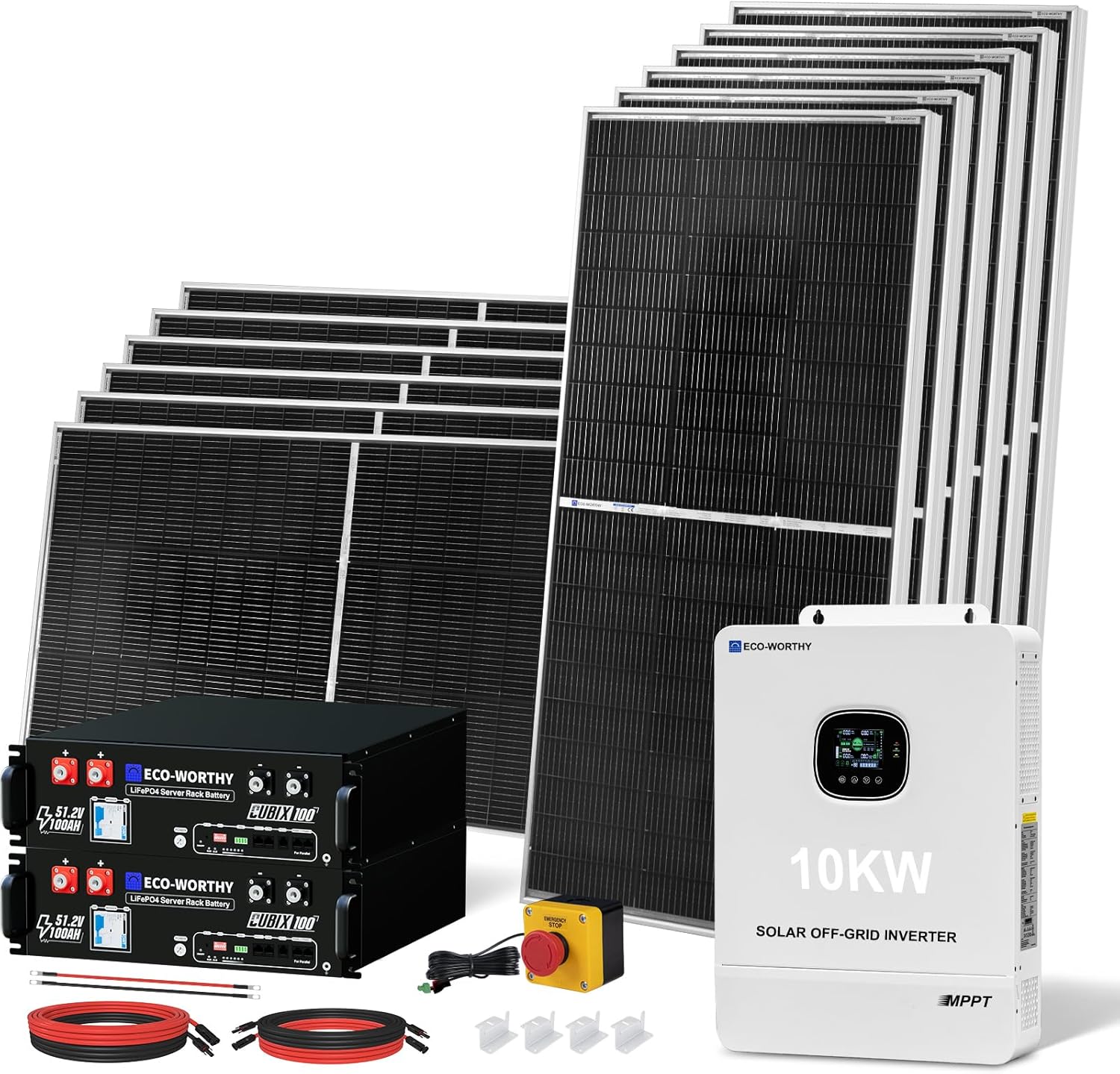
If you’ve been shopping for an off-grid solar battery kit on Amazon, you’ve probably come across the ECO-WORTHY 10KW Output 9.36KWH Off Grid Solar System Complete Kit. The title promises 10 kW of output, 12 solar panels, a UL-listed inverter, and two lithium batteries – all in one box. It sounds like a turnkey off-grid power solution.
But is it really a 10 kW system? After digging through the component specifications, the answer is: not quite. Here’s what the numbers actually say.
The Inverter: 10 kW Peak, 5 kW Continuous
The centerpiece of this kit is ECO-WORTHY’s 10,000W 48V hybrid inverter. That “10KW” in the product title? It’s the peak surge rating – the maximum the inverter can handle for a few seconds when a motor or compressor kicks on. The actual continuous output is 5,000 watts.
That’s not unusual for inverters in this class. Peak ratings are typically double the continuous rating. But when a product is marketed as a “10KW” system, most consumers reasonably assume that means 10 kW of usable, sustained power. It doesn’t.
Key Inverter Specs
- Continuous output: 5,000W (120V/240V split phase)
- Peak/surge output: 10,000W (seconds only)
- Max PV input: 5,500W
- MPPT charge current: 80A
- Certifications: UL 1741
The Batteries: Can They Even Deliver 10 kW Peak?
The kit includes two ECO-WORTHY 48V 100Ah LiFePO4 server rack batteries (UL 1973 and UL 9540A certified). Each battery has a built-in BMS rated for 100 amps of continuous discharge.
Here’s where it gets interesting. ECO-WORTHY does not publish a peak or surge discharge rating above the 100A continuous BMS limit for these batteries. That means the rated maximum discharge is:
- Per battery: 100A x 48V = ~4,800W
- Two batteries in parallel: 200A x 48V = ~9,600W
To hit the inverter’s 10,000W peak, you’d need roughly 208A from the battery bank (10,000W / 48V). With only 200A available across both batteries and no published surge rating, the batteries come up short – delivering about 96% of what the inverter can theoretically peak at. There’s essentially zero headroom.
Can Solar + Batteries Together Reach 10 kW?
During daylight hours, the inverter draws from both the PV array and the batteries simultaneously. With the 12 included 195W panels producing up to 2,340W (realistically 1,800-2,000W after system losses), the combined output can technically reach the 10 kW peak:
| Source | Max Contribution |
|---|---|
| 12 x 195W solar panels | ~2,000W (realistic) |
| 2 x 48V 100Ah batteries | ~9,600W |
| Combined | ~11,600W |
So yes – during peak sun hours, the system can meet the 10 kW surge. But the panels are only contributing about 20% of that number. The batteries are doing the heavy lifting, and they’re barely adequate on their own.
The scenario where you most need peak surge power – a nighttime power outage when the AC compressor kicks on – is exactly when you have zero solar contribution. At that point, you’re relying on batteries alone, and they can’t reliably deliver 10 kW.
Battery Charge Times: Mid-Atlantic Region Estimates
For homeowners in Maryland, Virginia, DC, and the broader Mid-Atlantic, here’s how long it takes to charge the included 10.24 kWh battery bank from empty using only the 12 included solar panels (assuming no simultaneous loads):
| Season | Peak Sun Hours | Daily Energy Harvested | Days to Full Charge |
|---|---|---|---|
| Peak Summer (June/July) | 5.0 – 5.5 hours | 9,594 – 10,553 Wh | ~1 day |
| Average Summer | 4.71 hours | 9,038 Wh | ~1.1 days |
| Average Winter | 3.84 hours | 7,367 Wh | ~1.4 days |
| Deep Winter (Dec/Jan) | 2.5 – 3.0 hours | 4,796 – 5,755 Wh | ~1.8 – 2.1 days |
These estimates use an 82% system derate factor that accounts for MPPT conversion efficiency, wiring losses, temperature derating, and panel mismatch. Peak sun hour data is sourced from NREL and state-level solar irradiance databases for the Maryland/Mid-Atlantic region.
On a good summer day with clear skies, you can just barely recharge the full bank in a single day. In deep winter? Expect about two days of charging – and that’s with nothing drawing power from the batteries during the day. Any consumption during charging extends these times proportionally.
The Solar Array Is Undersized Too
The inverter’s MPPT controller can accept up to 5,500W of solar input. The kit only includes 2,340W of panels – that’s just 43% of the inverter’s PV capacity. This further confirms that the kit is designed with expansion in mind rather than being optimally matched as shipped.
Why ECO-WORTHY Sizes It This Way
This isn’t necessarily deceptive – there are rational reasons for the component mismatch:
1. Expandability. ECO-WORTHY supports up to 32 batteries in parallel, and the inverter itself can be paralleled up to 6 units for 60 kW of output. This inverter is sized for a future, larger battery bank – not just the two that ship in the box.
2. One inverter, many SKUs. ECO-WORTHY sells this same inverter across kits with 2, 4, and 6 batteries. It’s simpler to stock one inverter model and scale the battery count than to manufacture multiple inverter sizes.
3. Daytime PV + battery hybrid output. During daylight, the inverter pulls from both sources simultaneously, making the peak rating achievable – at least while the sun is shining.
What Would Make This Kit Live Up to Its Name?
If you want this system to reliably deliver 10 kW of peak power around the clock – including during a nighttime power outage – you’ll need to expand beyond the base kit:
- Add at least 1 more battery (3 total = 300A / ~14,400W) for comfortable 10 kW peak headroom 24/7
- Add more solar panels to approach the 5,500W MPPT limit for faster charging and better daytime output
The Bottom Line
The ECO-WORTHY “10KW” kit is, in practice, a 5 kW continuous off-grid system with a peak surge rating that the included batteries can only almost deliver on their own. The “10KW” in the title is the inverter’s surge rating, not a usable power figure.
If you’re buying this kit as a starting point with plans to expand – adding more panels toward the 5,500W MPPT ceiling and a third or fourth battery to unlock the inverter’s full potential around the clock – it’s a reasonable foundation. But if you expect 10 kW of backup power tonight when the grid goes down, you’ll be disappointed.
As with most things in solar: read past the marketing headline and look at the component specs. The numbers don’t lie – even when the product title does.
Dennis Meizys is the founder of Solar Yoda LLC, an independent solar consulting firm based in Maryland since 2011. Got questions about off-grid solar, battery storage, or whether a kit is right for your home? Get in touch.
Leave a Reply