
Near BWI Airport, in Anne Arundel County, Maryland, a data center called Sandy Farms is asking to nearly double in size. Residents packed a community meeting to ask about noise, truck traffic and – the question on everyone’s mind – what all this computing does to their electric bills and their air.
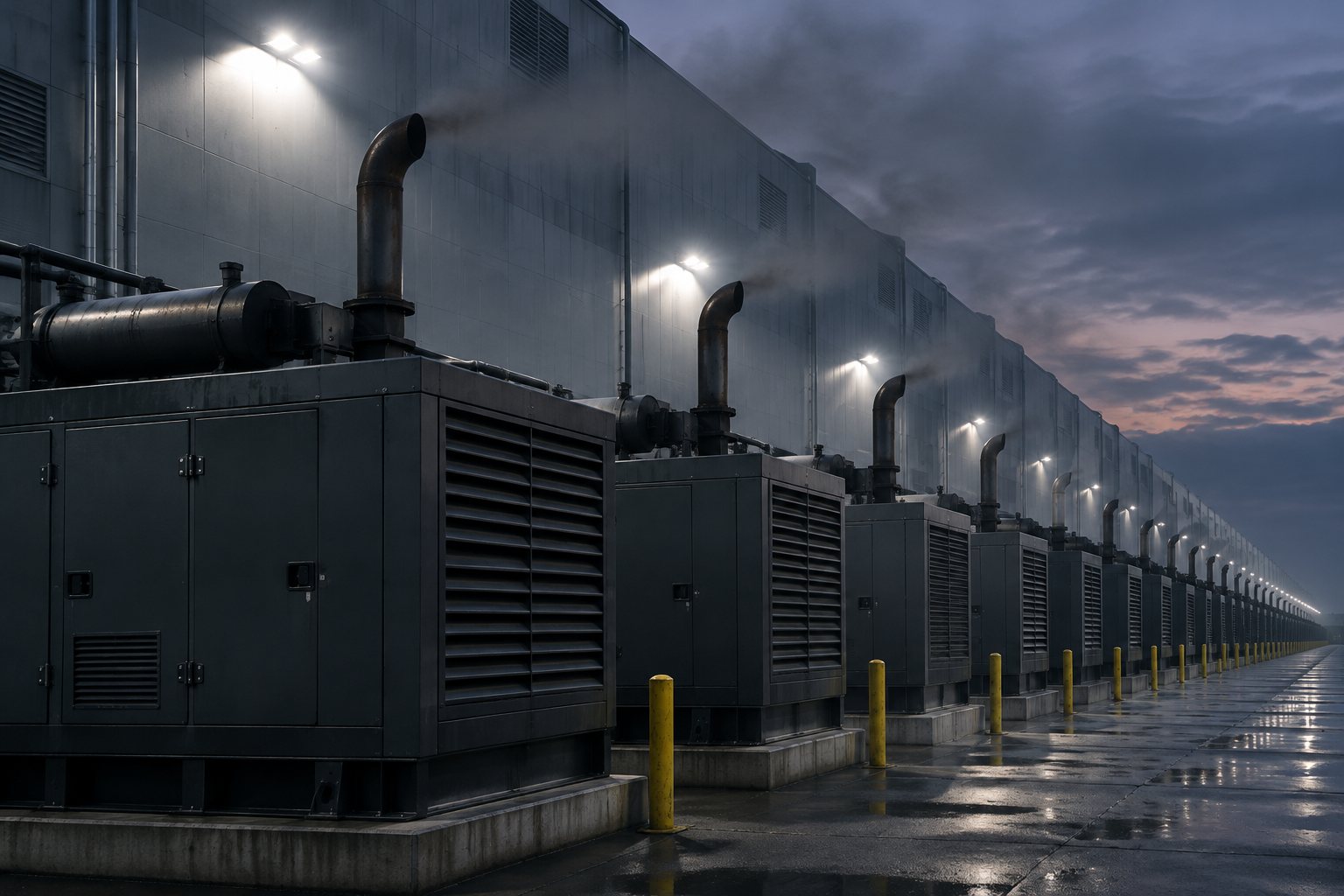
What most people don’t realize is that behind every data center like it sits a small power plant made of diesel engines. And the way those engines are permitted – as “emergency backup” – is quietly becoming one of the biggest air-quality loopholes in America.

What “emergency backup” is supposed to mean
A true emergency backup generator exists for one reason: keep the lights on when the grid fails. Air-quality permits reflect that. They typically cap engine run time at a few hundred hours per year, most of it testing and maintenance. The rest of the time, the engines sit silent.
That’s the rule. The question sweeping through state capitols and county hearing rooms is whether data center developers are following it – or stretching it until “backup” becomes prime power: engines that routinely produce electricity because the grid can’t keep up with the data center’s energy requirements.
Maryland: 168 diesel generators, one blunt answer
In 2023, a company called Aligned Data Centers (MD) Propco LLC asked Maryland’s Public Service Commission for permission to install 168 diesel generators rated at 3 megawatts each – about 504 megawatts of nameplate capacity – at a proposed data center in Frederick County. That’s not a backup system; that’s a medium-sized power plant wearing a backup label.
The PSC said no, denying the company’s request to exempt the project from full review in Order No. 90830. Clean Water Action’s public comments against the exemption laid out the stakes: particulate matter, nitrogen oxides and diesel exhaust in communities that already carry more than their share of air pollution. The episode helped spark Maryland’s current wave of data center legislation and local moratoriums.
Virginia: ten thousand generators, and a line that keeps moving
If Maryland drew a line, Virginia shows what happens on the other side of it. The state’s data center corridor is now permitted for roughly 10,000 diesel generators – around 26 gigawatts of capacity, more than many utilities generate in total – according to the Environment America report “False Emergencies, Real Pollution.”
And they don’t all stay silent. As Inside Climate News reported, regulators there have weighed letting data centers run their generators during periods of grid stress, after one facility ran its diesel fleet for nearly 24 hours straight while the region sweated through a heat emergency. Then in January 2026, federal reliability rules were changed so data centers on the PJM grid can rely solely on their generators during cold-weather emergencies. Read that twice: engines permitted as emergency equipment are being written into emergency plans as the power supply.
Pennsylvania: diesel fleets by the dozen
Pennsylvania has become a case study in how big “backup” gets. For an Amazon Data Services project in Falls Township, the state Department of Environmental Protection has been asked to permit 76 additional diesel-fired backup generators for a site that, as environmental policy analyst David Hess noted, was already permitted for more than a hundred diesel generators and four 12,000-gallon diesel storage tanks. Neighboring communities have faced similar proposals, including plans for dozens of “emergency” engines per site.
Closer to home, an air-quality permit application for an Amazon-linked project near BWI Airport – code-named BWI-150 – covers 99 diesel emergency generators, per DataCenterData’s permit tracking.
How to tell backup from prime power
- Run-hour limits. True emergency permits cap engines at roughly 100-500 hours per year. Requests for 1,000+ hours, “demand response” provisions, or peak-shaving language mean the engines are planned to work regularly.
- Fuel storage. Four 12,000-gallon tanks is not a test-run budget. Fuel capacity that measures days of continuous operation tells you what the engines are really for.
- Count. A hospital needs a few backup generators. When a permit lists dozens or hundreds of engines, the fleet is sized for a mission, not an outage.
- The paperwork itself. Air permits, not site plans, are where the truth lives. In Maryland, generator permits go through the Department of the Environment – a completely separate file from the county zoning review neighbors usually fight.
The alternative hiding in plain sight
Here’s what interests us most at Solar Yoda: data centers are buildings with enormous roofs and enormous parking lots, and they need reliable power 24/7. That’s the exact profile of rooftop solar plus solar carport canopies plus battery storage.

Solar won’t replace every diesel engine – life-safety code and uptime guarantees will always require some standby generation. But every kilowatt-hour generated on site is a kilowatt-hour the engines and the strained regional grid don’t have to supply. And for communities facing a new data center proposal, solar on the roof and over the parking lot is a visible, verifiable commitment – the opposite of a diesel fleet behind a berm.
The economics are moving fast too. Commercial solar systems under 1 MW AC still qualify for the 30% federal Investment Tax Credit, and solar canopies generate the kind of on-site power that shaves peak demand charges – the same demand charges that data center growth is inflating for everyone else.
Want solar on YOUR building?
Whether you run a commercial building or a home in Maryland, the same math applies: rooftop solar, canopy solar and battery storage cut your power bill while the grid keeps getting more expensive. Tell us a little about your property and Solar Yoda will run a free, no-obligation solar assessment – we have been doing the math on Maryland solar since 2011.
The takeaway
Data center energy requirements aren’t abstract anymore – they show up on utility bills and in permit hearings from Frederick County to Falls Township. When a developer presents a generator fleet as “backup,” the smart question for any planning board – or any reporter – is simple: How many hours per year are you requesting, and what happens when the grid operator calls?
If you’re evaluating solar for a commercial or industrial property in Maryland – or fighting for better energy choices in your community – talk to us at Solar Yoda. We’ve been doing the math on Maryland solar since 2011.
Sources
- Maryland Public Service Commission, Order No. 90830 (Provisional Order on Rehearing)
- Clean Water Action: Our comments against the CPCN exemption for 168 diesel generators
- Environment America: False Emergencies, Real Pollution
- Inside Climate News: Virginia Regulators Weigh Expanded Use of Data Centers’ Polluting Generators
- Inside Climate News: Data Centers in PJM Grid Can Rely Solely on Generators During the Cold, DOE Rules
- beSpacific (citing Inside Climate News): As data centers boom, Virginians breathe the exhaust of 10,500 diesel generators
- David Hess: DEP issues air quality permit to Amazon Data Services for diesel-fired backup generators (Falls Township, PA)
- DataCenterData: Data center permit and project updates
- Track Data Centers: Sandy Farms Data Center, Severn, Maryland
- CBS News Baltimore: Anne Arundel County data center developer wants to expand in Severn
Note: The images in this post are original illustrations created for Solar Yoda, not photographs of the specific projects discussed.
Leave a Reply